
Industry-leading demand forecasting
Applying cutting-edge AI research to fresh forecasting to accurately predict future sales for each product, at each store, on each day.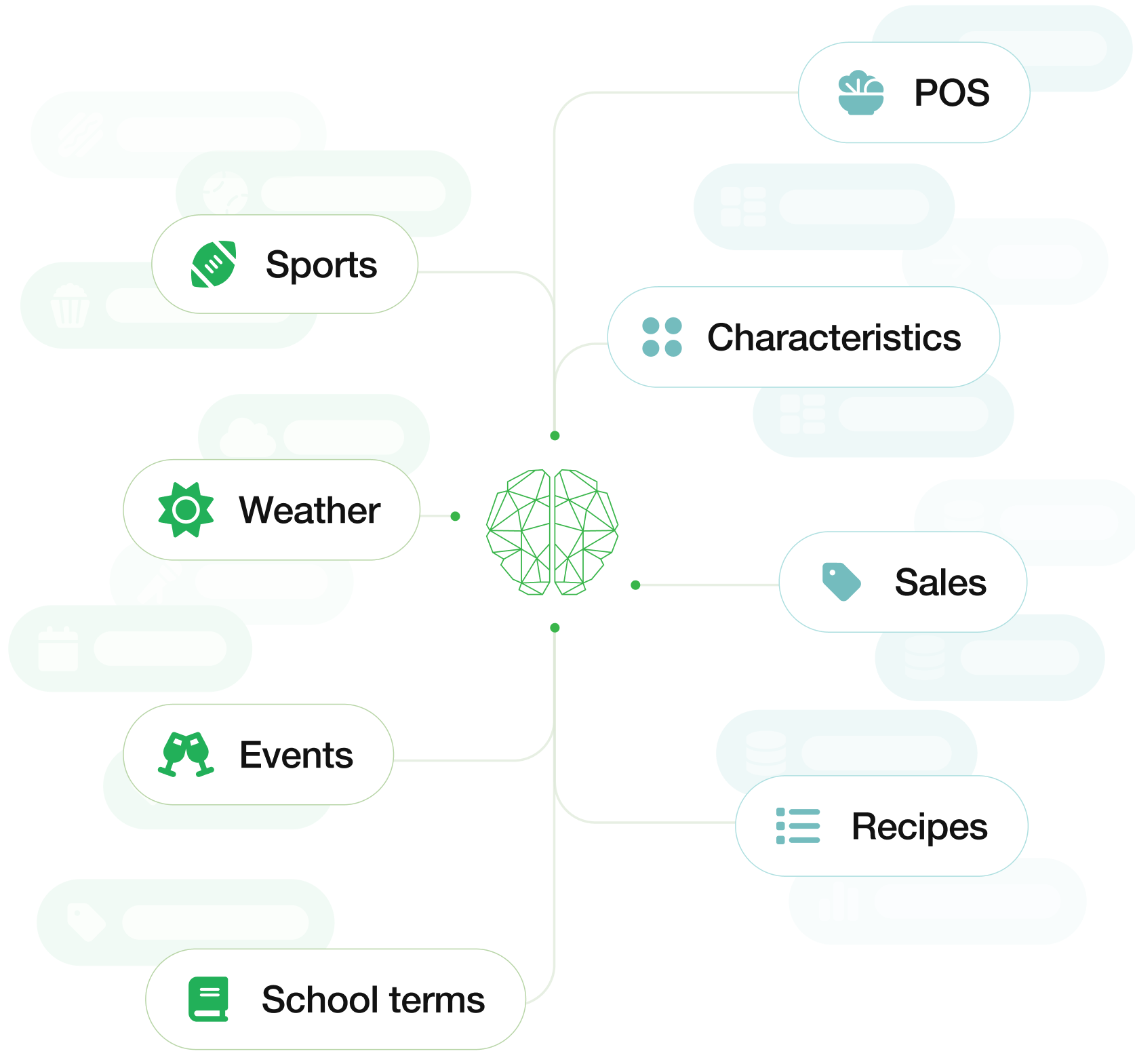
Our AI technology
An intelligent brain for item-level forecasting
Developed out of AI research, our proprietary algorithm takes a novel approach to deep learning that goes beyond traditional machine learning: it mimics the way that a human brain learns complex causal patterns at a very granular level. Traditional ML models get easily overwhelmed by too much data, struggling to capture individual nuances and often confusing correlation for causation. Our model architecture allows us to process billions of data points and better identify the causal interactions between the data points.
Forecast accuracy
Real-world understanding of your stores
We ground every forecast in the realities of each store: historical sales, on-hand and delivery patterns, promotion mechanics, local weather, holidays, school calendars, and hundreds of other signals. By continuously learning how these real-world data points drive demand at the item/store/day level, Guac separates true drivers from noise and stays accurate as conditions change.
Try our playground demoGuac Forecast Accuracy
Actual Sales
Guac Forecast
JanMarMayJuly
Tap the variables to turn the on
Examples of forecasting intelligence
 Promotions Data
Different promotion types
We incorporate how different promotion types affect sales differently: discounts, multi-unit ("2 for $10"), EDLP, and even social media promotions.
Halo & cannibalization effects
We capture halo & cannibalization effects of promotions to reflect true cross-product impacts.
After-promotion effect
We capture how sales go "back to normal" after a promotion ends.
 Weather Data
Local weather data per store
We incorporate weather data for the square mile radius around each of your stores.
10+ weather variables
We look at 10+ variables to contextualize weather, including the difference between weather forecasts and actual weather.
Extreme weather events
We incorporate how snowfall in Texas is different from snowfall in Maine — and we look at proxy datasets (e.g. road closures) to capture extreme weather events.
 Local Data
School term dates per store
We incorporate different local school term dates and key events (e.g. prom, graduation) for the specific school district that each of your stores is in.
Demographic data
We use demographic data from each of your stores' zip codes to capture demand drivers like SNAP EBT deposit schedules and cultural holidays.
200+ local data
We look at over 200 local variables to better understand how each of your customers shop.
Tailored to you
We train a custom algorithm that is unique to your stores
We work closely with you to add in any external variables to reflect the realities of your stores, not of an average grocery store.240+
external data variables4 weeks
average time spent customizing for each retailer


Meet with our team
We know that every retailer is different and that each department has its own unique needs. Share with us your specific business needs, and we'll build a solution that is perfect for you.